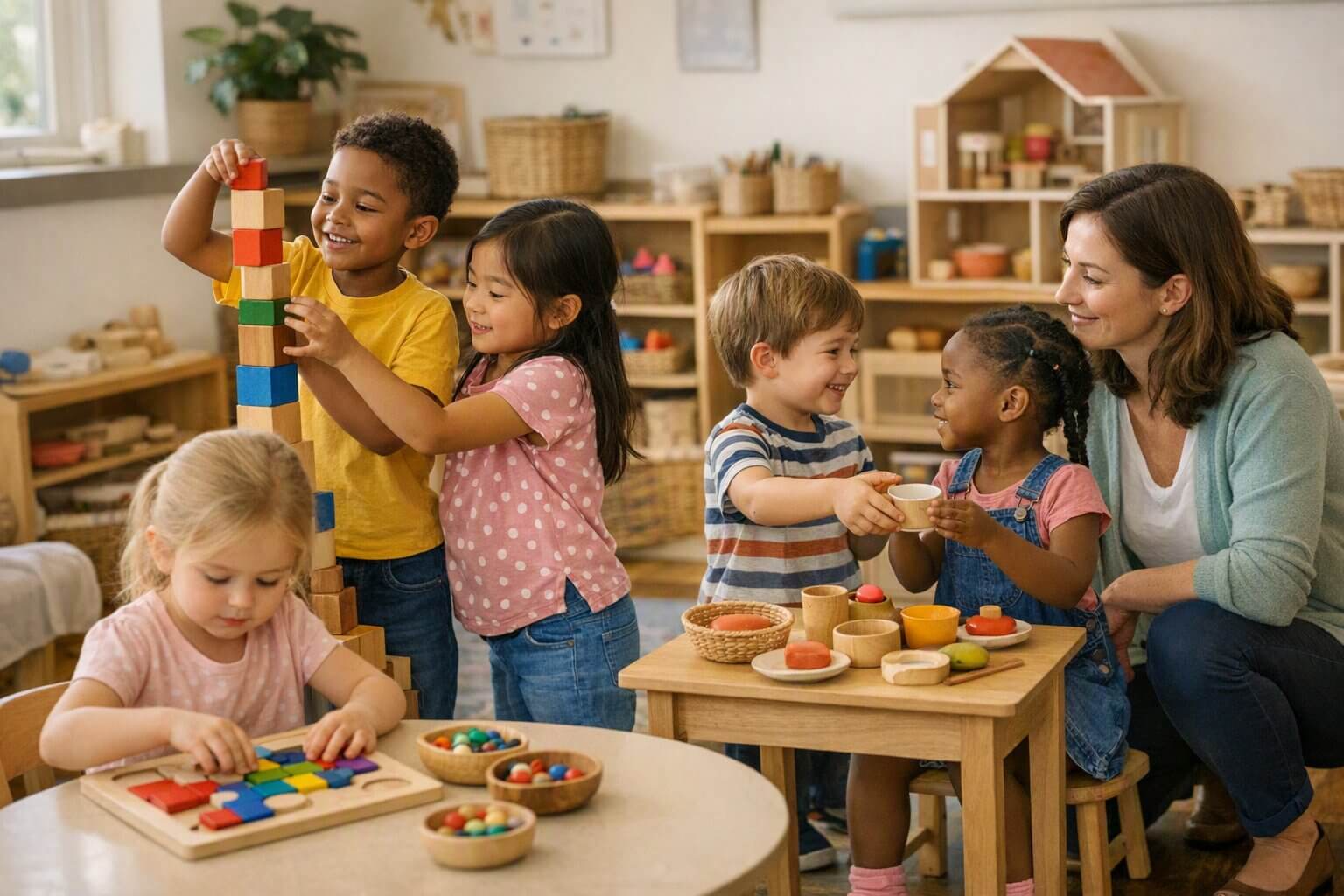
What looks like a simple game of building blocks can involve problem-solving, planning, communication and negotiation. When children pretend to run a café, care for a toy animal or construct a tower, they are doing far more than keeping themselves entertained.
They are testing ideas, learning how other people think and discovering what happens when their plans do not work the first time.
Play-based learning gives children the freedom to explore while educators and caregivers create opportunities that extend their thinking. When thoughtfully supported, play can help children build the cognitive, social and emotional skills they will use throughout school and later life.
Table of contents
- What play-based learning really means
- How play strengthens cognitive development
- How play builds social and emotional skills
- Different types of play and the skills they support
- The role of adults in purposeful play
- Supporting play-based learning at home
What play-based learning really means
Play-based learning is an approach that uses children’s natural curiosity and interests as a starting point for learning. Rather than asking children to memorise information through formal lessons, it encourages them to investigate, create, experiment and make decisions.
Play-based learning can be child-led, adult-guided or a mixture of both. A child might independently decide to build a bridge from blocks, while an educator may extend the experience by asking, “How could you make the bridge strong enough for this toy car?”
According to the Australian Children’s Education and Care Quality Authority, children build new understandings through play by testing ideas, interacting with others and challenging each other’s thinking. Educators contribute by deliberately creating environments and asking questions that support deeper learning.
How play strengthens cognitive development
Cognitive development describes how children learn to think, remember, concentrate, solve problems and understand the world around them. Play provides repeated opportunities to practice each of these abilities in meaningful situations.
For babies and toddlers, activities such as sensory play, singing, stacking objects and exploring different textures can encourage attention, early communication and cause-and-effect thinking. A well-designed early learning program may build on these natural discoveries with age-appropriate resources and educator-guided experiences that encourage children to investigate at their own pace.
As children grow, their play often becomes more complex. Building a train track requires them to plan ahead. Completing a puzzle encourages them to compare shapes and remember previous attempts. Pretending a cardboard box is a spaceship develops symbolic thinking, which helps children understand that one object, image or word can represent something else.
Play also supports executive function skills, including attention, working memory, flexible thinking and self-control. The Center on the Developing Child at Harvard University explains that these skills help people plan, concentrate, switch between tasks and manage multiple pieces of information.
| Play experience | Cognitive skills being practiced |
| Completing puzzles | Problem-solving, memory and visual recognition |
| Building with blocks | Planning, spatial awareness and early mathematical thinking |
| Sorting natural objects | Comparing, categorising and identifying patterns |
| Pretend play | Imagination, language and symbolic thinking |
| Playing memory games | Concentration, recall and attention |
| Experimenting with water or sand | Cause-and-effect thinking and early scientific reasoning |
Importantly, children do not need to complete an activity perfectly for learning to occur. A block tower that repeatedly falls teaches persistence, balance and the value of trying a different approach.
How play builds social and emotional skills
When children play together, they enter a small social world where they must communicate their ideas, listen to others and respond to different feelings.
A thoughtfully designed Transition to School Program can use collaborative play to help older preschool children practice turn-taking, independence, communication and problem-solving before they enter a school environment.
During group play, children regularly encounter situations that require compromise. Two children may want the same toy, disagree about the rules of a game or have different ideas about how a pretend story should unfold. With appropriate support, these moments become opportunities to practice:
- Sharing resources
- Expressing needs clearly
- Listening to another person’s ideas
- Managing frustration
- Negotiating roles and rules
- Recognising another person’s emotions
- Repairing friendships after disagreements
The American Academy of Pediatrics notes that developmentally appropriate play with adults and peers can support social-emotional, cognitive, language and self-regulation skills. ACECQA also highlights that play gives children opportunities to develop empathy, fairness and friendships.
Pretend play is particularly valuable for developing empathy. When a child acts as a doctor comforting a patient or pretends to care for a baby, they experiment with perspectives and emotions that may be different from their own.
Different types of play and the skills they support
Children benefit from experiencing several forms of play. Each offers different opportunities for growth.
| Type of play | Example | Skills supported |
| Sensory play | Exploring water, sand or playdough | Curiosity, concentration and fine motor control |
| Physical play | Running, climbing or dancing | Coordination, confidence and self-regulation |
| Constructive play | Building a road or creating a collage | Planning, creativity and persistence |
| Imaginative play | Running a pretend shop | Language, empathy and flexible thinking |
| Cooperative play | Completing a shared building project | Communication, negotiation and teamwork |
| Games with rules | Matching cards or simple board games | Memory, patience and turn-taking |
Children may move between several types of play within a single activity. For example, creating a pretend restaurant can involve constructive play while making signs, imaginative play while serving meals and cooperative play while deciding who will be the chef.
The role of adults in purposeful play
Play-based learning does not mean adults should always step back and leave children entirely on their own. Adults can enrich play without taking control of it.
The most effective support often begins with careful observation. By noticing what interests a child, an adult can introduce a useful resource, new word or open-ended question at the right moment.
For example, instead of showing a child exactly how to fix a collapsing tower, an adult might ask:
- “What do you notice about the blocks at the bottom?”
- “Which block could make the base stronger?”
- “What happened when you used the smaller block?”
- “What else could you try?”
This approach encourages the child to remain the problem-solver. The Australian Education Research Organisation describes intentionality in play-based learning as thoughtful and purposeful participation that extends children’s thinking while still respecting their ideas and interests.
Responsive back-and-forth interactions are especially important during the earliest years. Harvard’s research on serve-and-return interactions explains that attentive exchanges between a child and caring adult support early language, social abilities and later cognitive development.
Supporting play-based learning at home
Supporting learning through play does not require expensive toys or a detailed activity schedule. Everyday materials and experiences often provide the richest opportunities.
You can encourage meaningful play by:
- Offering open-ended items such as cardboard boxes, containers, fabric, blocks and drawing materials
- Allowing uninterrupted time for children to develop their own ideas
- Following your child’s interests rather than directing every activity
- Asking questions that have more than one possible answer
- Reading stories and acting out characters together
- Involving children in practical activities such as gardening, cooking and sorting laundry
- Allowing mistakes and giving children time to find their own solutions
It is also helpful to resist the urge to turn every game into a lesson. Children learn best when they remain interested, active and able to make meaningful choices.
Make room for purposeful play
Play helps children understand how objects work, how ideas connect and how relationships develop. It gives them a safe space to take manageable risks, cope with disappointment and try again.
The strongest play-based experiences balance freedom with thoughtful adult support. By offering time, engaging environments and responsive interactions, caregivers and educators can help children develop into curious thinkers, confident communicators and considerate members of their communities.