Key Takeaways
- Dynamic Precision Tool & Manufacturing supports CNC milling, CNC turning, grinding, wire EDM, tooling, fixturing, and inspection.
- The company states that it can machine parts to tolerances as tight as 0.0005 inch, depending on the application.
- Published capacity includes milling up to 60 inches long and turning up to 28 inches in diameter and 48 inches long.
- Prototype and short-run production work can help manufacturers move from design review to usable parts without committing to high volumes.
- A detailed CNC machining request for Michigan should include drawings, material, quantity, tolerances, inspection requirements, and delivery expectations.
Michigan manufacturers often need more than a shop that can simply cut metal. They need a dependable resource for tight tolerances, complex geometries, difficult materials, prototypes, and short production runs. Dynamic Precision Tool & Manufacturing brings CNC machining, grinding, wire EDM, tooling, fixturing, and inspection capabilities together at its Troy, Michigan, facility.
For buyers evaluating CNC machining Michigan, the best fit is usually a partner that can review the complete part requirements, select a practical machining approach, verify critical dimensions, and communicate clearly from quote through delivery.
What Should Michigan Manufacturers Look for in a CNC Machining Partner?
A capable CNC machining partner should offer more than machine time. Look for process range, material knowledge, inspection resources, practical problem-solving, and the ability to support a project through multiple stages. This becomes especially important when a component has critical fits, nonstandard stock, intricate features, or a short development schedule.
Dynamic Precision Tool & Manufacturing reports more than 30 years of experience at its Troy facility. Its combination of machining, grinding, wire EDM, in-house fixturing, and tooling can be valuable for customers who prefer a single coordinated manufacturing source rather than managing several specialty suppliers.
Handling Tight Tolerances and Critical Features
Tight tolerances matter when parts must assemble consistently, locate accurately, seal properly, or perform reliably under load. Dynamic Precision Tool & Manufacturing lists a tolerance capability of 0.0005 inch. However, the drawing requirement should always match the part’s function. Specifying an unnecessarily restrictive tolerance can increase cost and lead time without improving performance.
Precision depends on more than the CNC program. It also depends on workholding, tool condition, material behavior, machine setup, inspection methods, and the sequence of operations. Accurate dimensional measurement is essential because precision parts must fit and operate as intended.
CNC Milling, Turning, and Multi-Axis Machining Services
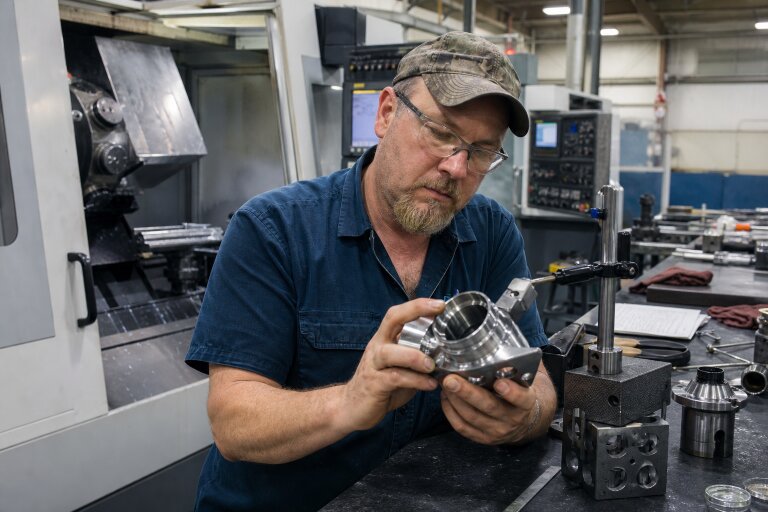
Dynamic Precision Tool & Manufacturing offers a broad range of machining operations to support both prismatic and round components. Its published equipment resources include Hurco and Fadal machining centers, Mazak turning centers, and a Miyano multi-axis turning center.
- CNC milling: Milling, drilling, boring, pocketing, profiling, reaming, facing, contouring, counterboring, and countersinking for detailed parts and machined features.
- CNC turning: Straight, taper, form, contour, and hard turning for shafts, bushings, housings, pins, and other cylindrical components.
- Threading: Internal and external threading, tapping, and thread milling for parts that must fasten, connect, or mate with other assemblies.
- Multi-axis capability: Four-axis milling, five-axis turning, live tooling, and seven cutting axes can reduce setups and make complex features more practical to machine.
Part Sizes and Production Capacity
Published machining dimensions provide a useful starting point when determining fit. Dynamic Precision Tool & Manufacturing lists milling capacity up to 60 inches in length, 30 inches in width, and 30 inches in height. Its turning capacity extends up to 28 inches in diameter and 48 inches in length. Bar-feeding capability is listed for stock up to 12 feet long and 3 inches in diameter.
Final feasibility still depends on the complete project. Part geometry, material condition, workholding requirements, tolerance zones, surface finish, and inspection criteria can all affect the manufacturing plan. Supplying complete technical information early helps prevent avoidable revisions later.
Prototype and Short-Run Manufacturing Support
Prototypes and short production runs require a different level of attention than repeat high-volume work. Engineering teams may need to revise dimensions, test assembly fit, evaluate material choices, or adjust a feature after initial inspection. A supplier with in-house tooling and fixturing capabilities can help establish a repeatable approach as a project moves from prototype to a limited production run.
Dynamic Precision Tool & Manufacturing specializes in prototypes and short runs, with a typical lead time of four to six weeks. Rush service may be available for urgent needs, although timing depends on complexity, material availability, required external processes, inspection requirements, and current production capacity.
Material Experience for Metals, Alloys, and Plastics
Material selection has a major effect on machining. Cutting speeds, tooling, heat control, chip formation, distortion risk, and finishing requirements can vary significantly between materials. Dynamic Precision Tool & Manufacturing lists experience with common metals, including steel, stainless steel, aluminum, brass, bronze, copper, and titanium.
The company also lists exotic and nickel-based materials, including Inconel, Hastelloy, Monel, Nitronic 60, tungsten, and molybdenum. For polymer components, the listed materials include nylon, Delrin, ABS, acrylic, Lexan, Vespel, polypropylene, UHMW, PVC, and PEEK, as well as unsintered ceramic. Buyers should specify the exact material grade, condition, and certification requirements before requesting a quote.
Inspection Resources That Support Part-to-Print Accuracy
Inspection is the process of verifying a machining process against the drawing. Dynamic Precision Tool & Manufacturing lists a coordinate measuring machine, optical comparators, profilometers, height gages, air gages, dial bore gages, and surface plates among its inspection resources. It also lists capabilities for surface roughness and hardness testing.
Not every feature requires the same measurement method. Critical bores, thread forms, profiles, surface finishes, and datum relationships should be identified on the drawing so that inspection can focus on the characteristics that matter most to the part’s function.
Industries and Applications Served
Dynamic Precision Tool & Manufacturing identifies aerospace, defense, automotive, medical, technology, and oilfield technology as its industry focuses. These sectors may have different needs for traceability, materials, documentation, tolerances, testing, and delivery controls. The company also lists assemblies, critical parts, precision components, and production parts as intended applications.
Its website includes references to ISO certification and ITAR registration. Because certification status and project-specific compliance requirements can change, buyers should request current documentation and confirm requirements before placing regulated or controlled work.
What to Include in a CNC Machining Michigan Request
A complete request gives the shop the information needed to assess manufacturability, process planning, and delivery expectations. Include the following:
- Part drawings and 3D CAD files, such as DXF, IGES, STEP, or DWG files.
- Material grade, condition, and any required certifications.
- Prototype quantity, short-run quantity, or expected production volume.
- Critical dimensions, tolerances, surface finish, hardness, and coating requirements.
- Inspection reports, documentation, packaging, shipping location, and target delivery date.
Why an Integrated Michigan Machine Shop Can Simplify Projects
Coordinating machining, tooling, fixturing, grinding, wire EDM, and inspection into a single operation can significantly reduce handoffs, simplifying communication and part movement. While this approach does not replace a thorough engineering review or customer approval, it effectively streamlines the process from drawing to finished component. Dynamic Precision Tool & Manufacturing offers a variety of CNC machining services, with expertise in materials and inspection. Please submit your project details to confirm our capabilities and lead times for your parts.
Conclusion
Choosing a CNC machining partner involves evaluating technical capabilities, inspection resources, material experience, and production capacity alongside project requirements. Providing complete drawings, specifications, and delivery expectations helps support accurate planning and efficient manufacturing. Careful preparation improves communication, reduces uncertainty, and contributes to successful prototype and short-run machining projects.